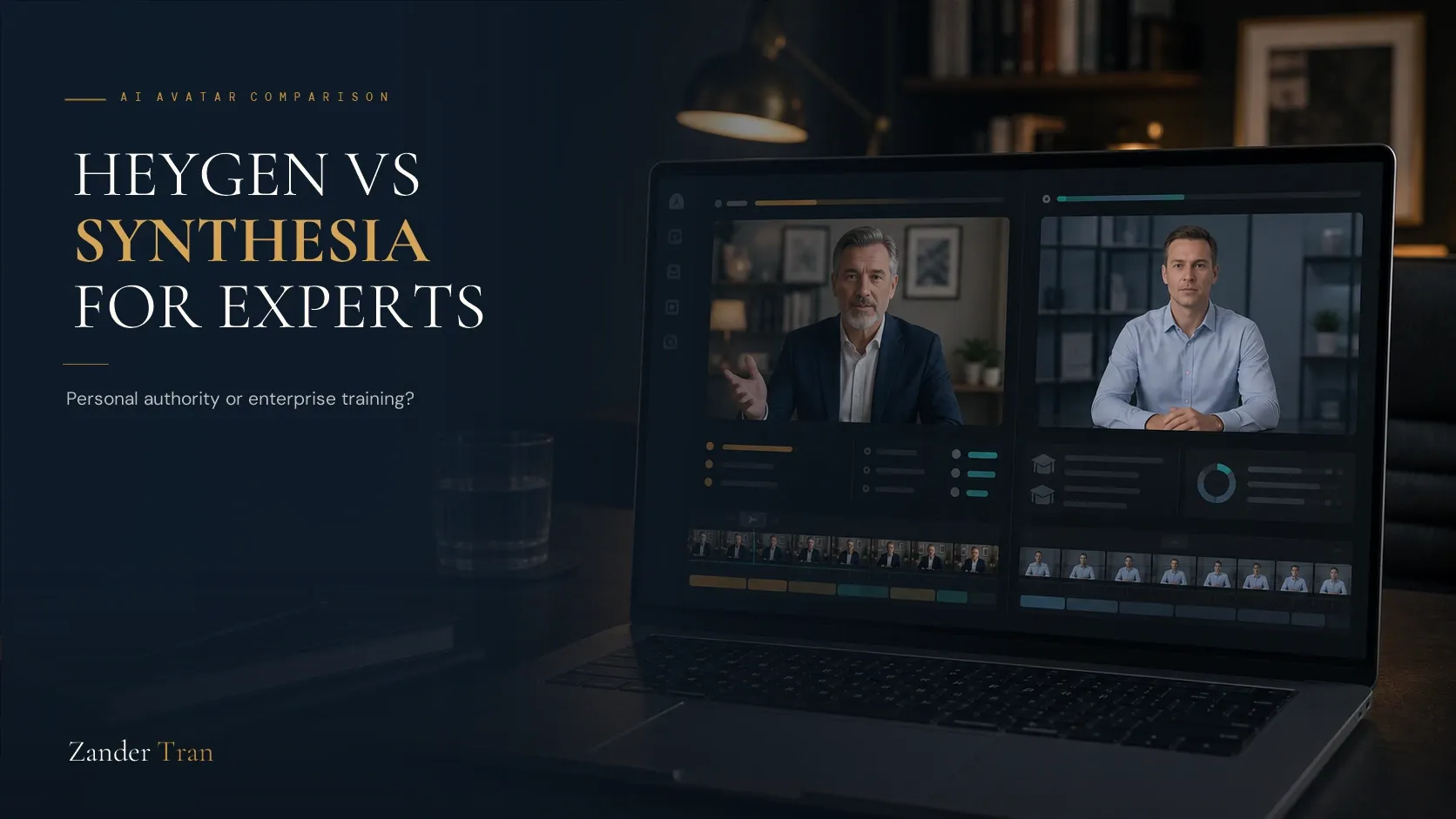
Whether you searched "HeyGen vs Synthesia" or "Synthesia vs HeyGen," you're asking the same question from two directions: which AI avatar tool is actually worth paying for. The honest answer depends less on which tool is "better" in the abstract and more on what you're actually trying to build.
I use HeyGen, and I'll tell you exactly why below, along with where Synthesia genuinely wins. This isn't a coin flip dressed up as a comparison. Quick disclosure: the HeyGen links here are affiliate links, and I earn a commission if you subscribe, at no cost to you.
Then keep reading, because the reason one of these tools fits you and not the other has almost nothing to do with which one scores higher on a feature checklist.
Fast Facts: The Comparison at a Glance
| HeyGen | Synthesia | |
|---|---|---|
| Free tier | 3 videos/mo, 1 min max | 10 min/mo |
| Entry paid price | $29/mo (Creator) | $18/mo annual, $29/mo monthly (Starter) |
| Avatar realism | Independently scored ~9.2/10, most expressive available | Independently scored ~8.2/10, polished but more neutral |
| Built for | Marketing, personal content, authority-building | Enterprise training, compliance, L&D |
| Language support | 175+ languages | 160+ languages |
Avatar Realism and Expressiveness
What I Found: independent reviews consistently put HeyGen ahead here, and my own daily use backs it up. Avatar IV's micro-expressions, natural eye movement, and hand gestures read closer to a real person on a video call than anything else I've tested. Synthesia's avatars are polished and professional, accurate lip-sync, natural enough movement, but deliberately more neutral and consistent.
That word, deliberately, is the entire story of this comparison.
What Each Tool Is Actually Built For
What I Found: Synthesia's neutrality isn't a limitation. It's the point. Synthesia is built for enterprise training and compliance content, where a video recorded in January needs to look and feel identical to one recorded in June. An L&D department doesn't want personality variance across fifty training modules. They want consistency they can govern at scale, which is exactly what SCORM export and Synthesia's enterprise tooling deliver.
HeyGen is built for the opposite problem. You're not producing fifty interchangeable training modules. You're building one recognizable voice that a reader learns to trust over time, which rewards the expressiveness and personality HeyGen's Avatar IV model is tuned for.
If you're an experienced professional building visible authority, not a corporate training department, this is the entire comparison. The tool built for governed sameness is the wrong tool for building a recognizable personal voice.
Pricing Comparison
What I Found: on paper, Synthesia's entry price looks close to HeyGen's. The real comparison is what that price buys. Synthesia's Starter plan gives you ten minutes a month on the monthly billing option, the same as its free tier, with the discount only showing up on annual commitment. HeyGen's Creator plan gives you roughly six hundred credits a month, which covers meaningfully more standard-avatar video even before factoring in that HeyGen's free tier alone lets you test three full videos before paying anything.
Neither is expensive at this stage. But minute-for-minute, HeyGen's entry tier stretches further for someone publishing on a regular schedule.
Ease of Use and Learning Curve
What I Found: both tools are built to be usable without a production background, which is the baseline requirement for either of them to matter to this audience. Synthesia leans slightly more toward structured, template-driven workflows, useful if you're producing similar training content repeatedly and want consistency built into the process itself. HeyGen's workflow is more open, script it and generate, which suits a publishing schedule where each piece of content is a genuinely new idea rather than a variation on a fixed template.
Neither has a steep learning curve. The difference is what the workflow assumes you're repeating versus what it assumes you're creating fresh each time.
Who Picks Wrong, and Why
The most common mistake I see is a solo expert choosing Synthesia because it shows up first in generic "best AI avatar tools" roundups aimed at corporate buyers. They end up with a tool tuned for governed sameness when what they actually needed was a tool tuned for a recognizable, expressive personal voice. The reverse mistake is rarer but real: an L&D team choosing HeyGen for its expressiveness, then discovering they actually needed Synthesia's compliance-grade consistency across fifty modules recorded over a year.
Neither mistake is about picking a "worse" tool. Both are about picking the tool built for someone else's problem.
Synthesia vs HeyGen: Does Search Direction Change the Answer?
No. Whichever way you typed the search, the underlying question is the same, and so is the answer: it depends on whether you're building governed enterprise training or a personal authority platform. For enterprise L&D, Synthesia's consistency and compliance tooling are the right call. For an experienced professional building one recognizable voice people learn to trust, HeyGen's expressiveness is the better investment.
The Verdict
For the reader this site is written for, HeyGen wins, and not by a narrow margin. The expressiveness that makes Avatar IV stand out is exactly what a personal authority platform needs. Synthesia's real strength, governed consistency across enterprise training content, solves a problem most solo experts don't have.
Try HeyGen → (affiliate link) Then read the full HeyGen pricing breakdown to find the right plan for your publishing pace.
See how both scored against 10 other avatar, voice, video, and email tools in the 2026 AI Tools Benchmark Report.
Watch The Invisible Expert Method
19 years building authority platforms for celebrities and executives. Now I built one for myself, without going on camera. Watch the free training to see exactly how it works.
Watch FreeWhich is more realistic, HeyGen or Synthesia?
HeyGen, according to independent testing and my own daily use. Avatar IV's micro-expressions and gestures are the most natural I've seen from any avatar tool. Synthesia is polished and professional but more deliberately neutral.
Is Synthesia better than HeyGen for anything?
Yes, enterprise training and compliance content. Synthesia's consistency across large volumes of governed content, plus SCORM export for learning management systems, makes it the stronger choice for corporate L&D teams specifically.
Which is cheaper, HeyGen or Synthesia?
Close on paper, but HeyGen's credit system stretches further for regular publishing once you compare actual usable video minutes rather than sticker price alone.
Can I use Synthesia for personal branding instead of enterprise training?
You can, but you'd be using a tool tuned for governed neutrality to do a job that rewards personality and expressiveness. It'll work. It won't be the better tool for that specific job.
Do HeyGen and Synthesia support the same languages?
Both support well over 150 languages, HeyGen at 175+ and Synthesia at 160+. For most readers, either covers the languages you'd actually need.