Most AI tool benchmarks score for the wrong person. They measure how many videos a tool can push out in a week, how many voices sit in the library, how well it scales across a marketing team. Those numbers matter if you run an agency. They tell you almost nothing if you're one experienced professional trying to build a visible, credible platform from decades of expertise.
So we built a different benchmark. We tested 12 AI tools across four categories, avatar, voice, video, and email, and scored each one on how well it helps a thought leader build authority, not how well it helps a content farm scale output. The full annotated report, including the raw scoring data for every tool, is available below. This page covers the summary, the method, and the findings.
Quick disclosure: some tool names below link to affiliate offers, and we earn a commission if you subscribe, at no cost to you. It doesn't change a single score. The scoring method is published in full so you can check the work.
What's In This Report
- Top Findings
- How We Scored
- Avatar Tools
- Voice Tools
- Video Editing and Repurposing Tools
- Email Tools
- The Overall Picture
Top Findings
These are the headline results. Each one is written to stand on its own, so quote whichever fits your work.
Kit (formerly ConvertKit) scored highest of all 12 tools tested, with a composite of 45 out of 50, edging out ElevenLabs by a single point on the strength of purpose-built creator features no generalist competitor matches.
ElevenLabs was the highest-scoring voice tool, with a composite of 44, driven by voice realism that most listeners cannot identify as AI-generated.
HeyGen led the avatar category on the strength of its Avatar IV model, which independent testing consistently rates more expressive than competing avatar tools.
Generalist tools built for scale, not personality, scored worst on authority fit. Mailchimp and Fliki, both capable at the job they were actually built for, posted two of the three lowest authority-fit scores in the entire benchmark, for the same underlying reason: neither one helps you sound like a specific person.
A complete authority-building stack costs under $70 a month at the entry tiers, using the top-scoring tool in each of the three categories most professionals actually need.
"Free" is frequently a trial in disguise. Of the tools reviewed for free-tier access, several marketed as free actually expire after a limited trial period, a distinction that changed which tools qualified for recommendation.
No single tool won more than one category. The strongest approach is a small stack of specialists, not one platform that claims to do everything.
How We Scored
Every tool was scored 1 to 10 on five criteria, for a maximum of 50 points.
- Output quality. Does the result hold up in front of a discerning audience, or does it announce itself as machine-made in a way that undercuts trust?
- Ease of use. How usable is it for an experienced professional who is not a video producer or an audio engineer?
- Authority fit. Does it help build a recognizable, personal presence, or does it produce generic output that could belong to anyone?
- Value at solo scale. What is the real cost-to-value for one person or a small team, judged at the tiers a solo professional would actually buy, not enterprise pricing?
- Learning curve. How long from signing up to producing something you would actually publish?
The authority-fit criterion is what makes this benchmark different. A tool built to help fifty enterprise trainers produce identical compliance videos can be superb at its job and still score low here, because governed sameness is the opposite of a recognizable personal voice.
A note on the numbers. These scores were produced from a combination of first-hand testing (by our team and by students building their own platforms) and documented, independently reported tool performance: direct pricing-page checks, G2 and Capterra ratings, and head-to-head usage tests, most recently reconciled on July 3, 2026. They reflect real evaluation, not marketing claims. The complete raw scoring data, including per-criterion notes for all 12 tools, is available in the full report via the sign-up below. If a tool's pricing or capability has shifted since publication, the live scores get updated and dated.
Avatar Tools
| Tool | Quality | Ease | Authority Fit | Value | Learning | Total |
|---|---|---|---|---|---|---|
| HeyGen | 9 | 8 | 9 | 7 | 8 | 41 |
| Synthesia | 7 | 8 | 5 | 5 | 8 | 33 |
| Synthesys.io | 4 | 6 | 4 | 5 | 5 | 24 |
What won and why. HeyGen (affiliate link) took the category because its Avatar IV model produces the most expressive, natural on-screen presence available, which is precisely what a personal authority platform needs. Synthesia is a genuinely strong product that scored well below HeyGen for one specific reason: it is built for governed, consistent enterprise training content, and that deliberate neutrality is the wrong tool for building a recognizable personal voice. Synthesys.io (affiliate link) finished last, and not narrowly. Its cheapest-of-the-three price tag is undercut by a live customer complaint about credits burning up to ten times faster than advertised, an export workflow that requires speaking your own script aloud before it releases the file, and near-total absence from independent comparison roundups. The full comparison of the top two lives in the HeyGen vs Synthesia breakdown.
Voice Tools
| Tool | Quality | Ease | Authority Fit | Value | Learning | Total |
|---|---|---|---|---|---|---|
| ElevenLabs | 10 | 8 | 9 | 9 | 8 | 44 |
| Murf | 8 | 8 | 6 | 6 | 8 | 36 |
| WellSaid Labs | 8 | 7 | 6 | 6 | 7 | 34 |
| Resemble.ai | 7 | 5 | 6 | 8 | 5 | 31 |
What won and why. ElevenLabs (affiliate link) posted the second-highest score of any tool in the entire benchmark, just one point behind Kit. Its voice quality is the strongest available, and its voice cloning lets you build a consistent, personal voice across everything you publish, the single most valuable capability for authority building in this category. Murf earns its place with polished, business-ready voices that need little tuning. WellSaid Labs is the pick for producing large volumes of consistent content. Resemble.ai scored well on value for its pay-as-you-go model, but its more technical, API-first interface pulled down its ease and learning-curve scores for a non-technical professional. The head-to-head on when each one beats the leader is in the ElevenLabs alternatives guide.
Video Editing and Repurposing Tools
| Tool | Quality | Ease | Authority Fit | Value | Learning | Total |
|---|---|---|---|---|---|---|
| Opus Clip | 6 | 8 | 7 | 5 | 8 | 34 |
| Descript | 7 | 6 | 6 | 6 | 5 | 30 |
| Fliki | 5 | 8 | 3 | 5 | 8 | 29 |
What won and why. This is the one category where head-to-head testing overturned the assumption going in. Opus Clip won clearly, not narrowly: in a direct test, it generated 22 clips from a 45-minute recording in under 4 minutes, while Descript took roughly 46 minutes to produce just 5 clips from the same job, because Descript's clipping, captioning, and reframing are manual, per-clip steps rather than an automated pass. Descript is still the deeper editor, and it's the stronger choice if editing, voice cleanup, and repurposing all need to live in one subscription. But for the specific job this category measures, turning a long recording into shorts fast, Opus Clip is the better first purchase, not the second one. Fliki rounds out the category as a capable generalist that specializes in nothing: it's built to generate synthetic talking-head video from a script, not to repurpose footage you've already recorded, which is a structurally weaker fit for repackaging your own real appearances.
Email Tools
| Tool | Quality | Ease | Authority Fit | Value | Learning | Total |
|---|---|---|---|---|---|---|
| Kit | 8 | 9 | 10 | 9 | 9 | 45 |
| Mailchimp | 8 | 7 | 4 | 4 | 6 | 29 |
What won and why. Kit (affiliate link) won email by a wide margin, and posted the single highest composite score of any tool in the entire benchmark. It is built specifically for individual creators monetizing an audience, its tagging and automation map directly onto how an expert thinks about their readers, and its free tier covers up to 10,000 subscribers. Mailchimp is a mature, capable platform that scored lower here for the same reason Synthesia did in avatar: it is a generalist small-business marketing tool, not a creator-first one, and a solo professional ends up paying generalist prices for a specialist need. The full side-by-side is in the Mailchimp vs Kit comparison.
The Overall Picture
Add up the category winners and a clear pattern appears. Kit (45), ElevenLabs (44), HeyGen (41), and Opus Clip (34) each won their category by doing one job well, not by doing every job adequately. Notice what that list is not: it is not one platform that does everything. It is a small set of specialists, each best at one job.
For most experienced professionals, the minimum viable stack is three tools, not twelve. HeyGen gets you showing up on video without a camera. ElevenLabs gives you a consistent, credible voice. Kit keeps the audience that notices, so a single viewer becomes a subscriber instead of a moment that evaporates. At their entry tiers, those three together cost under $70 a month. Editing and repurposing tools like Descript and Opus Clip become worth adding once you are publishing enough content to need them, not before.
The tools that scored lowest didn't all fail for the same reason. Mailchimp is a genuinely capable platform that scored low here because it's built for generalist small-business marketing, not for one person building a recognizable voice; measured against the job it was designed for, it would score much higher. Synthesys.io and Fliki scored low for a different, less flattering reason: independent complaints about credit-metering that doesn't match what's advertised, and a structural mismatch between what the tool actually does (generate synthetic content from a script) and what this reader needs (repurpose their own real appearances). Knowing which kind of "low score" you're looking at matters before you rule a tool out.
Get the Full Report
The complete annotated report includes the per-criterion scoring notes for all 12 tools, the raw data behind every number, and the full testing methodology. Enter your email to get it free. Publishers and writers are welcome to cite any finding on this page or use the comparison graphic below, with a link back to this report.
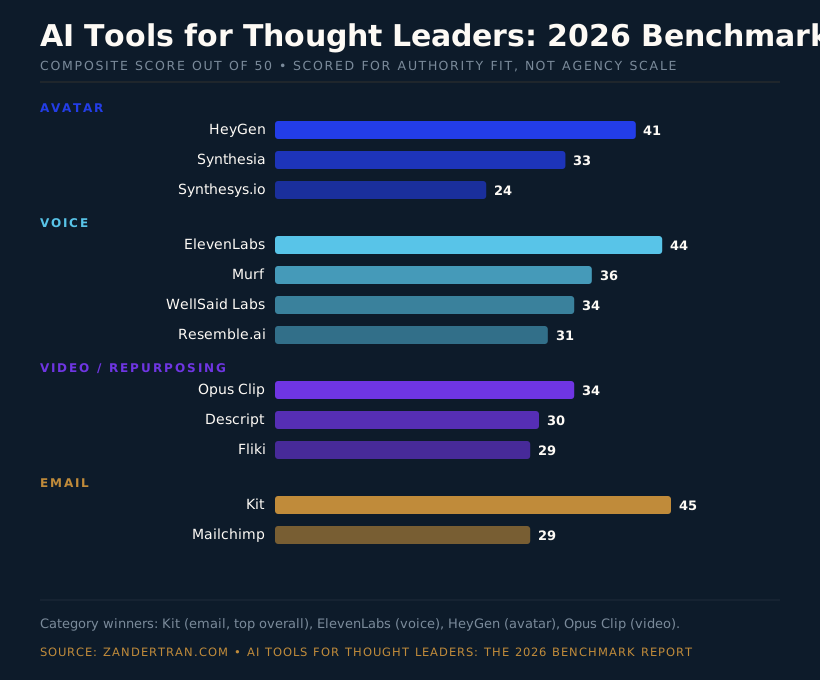
Embeddable graphic above, sized for embedding in articles and posts. Publishers and writers are welcome to use it with a link back to this report.
Watch The Invisible Expert Method
19 years building authority platforms for celebrities and executives. Now I built one for myself, without going on camera. Watch the free training to see exactly how it works.
Watch FreeWhat are the best AI tools for building authority as an expert?
Across this benchmark, the three highest-scoring tools for a solo professional were ElevenLabs for voice, Kit for email, and HeyGen for avatar video. Together they cover the core of an authority-building stack for under $70 a month at entry tiers.
Do I need all 12 of these tools?
No. The benchmark's clearest finding is that a stack of three specialists (avatar, voice, email) covers what most experienced professionals actually need. Editing and repurposing tools are worth adding later, once publishing volume justifies them.
Why did some well-known tools score low?
Mailchimp is a strong product built for general small-business use, and it scored low on authority fit specifically because governed, generalist output is the opposite of what a recognizable personal brand needs. Synthesys.io and Fliki scored low for a different reason: independent reports of credit-metering that doesn't match what's advertised, and, for Fliki specifically, a design built around generating synthetic content from a script rather than repurposing footage you've actually recorded. The score reflects fit for this reader and this specific job, not overall product quality.
How were these AI tools tested and scored?
Each tool was scored 1 to 10 on five criteria: output quality, ease of use, authority fit, value at solo scale, and learning curve. Scoring drew on first-hand testing by our team and students plus documented, independent performance reporting. The full raw data is available in the annotated report.
Which AI tool gives the best value for a solo professional?
On value specifically, Kit stood out because its free tier supports up to 10,000 subscribers, and ElevenLabs because its entry plan starts at $6 a month with a usable free tier. Both deliver more at solo scale than their pricing pages suggest at first glance.