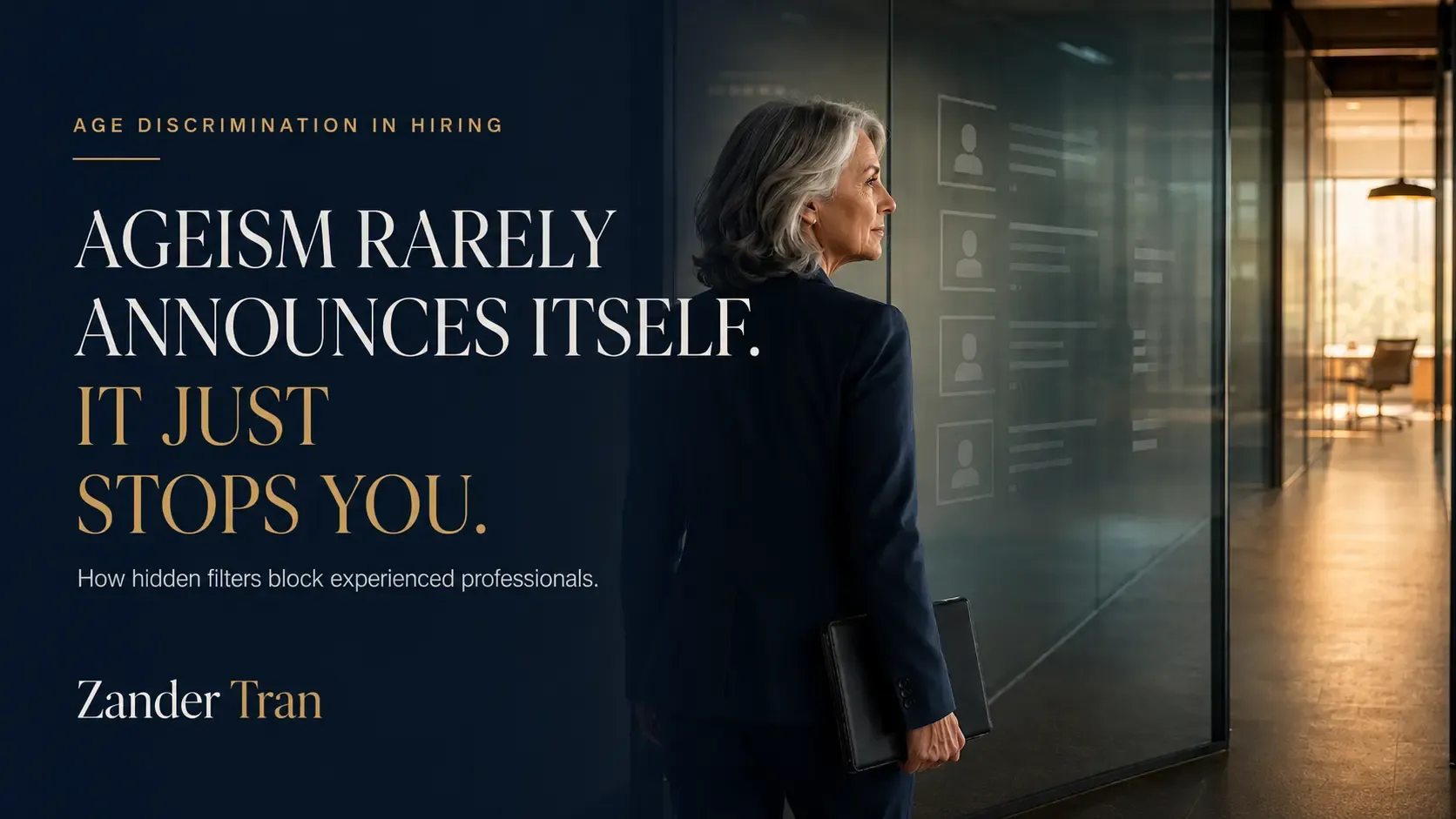
The calendar invite had no agenda.
14 years. VP of Operations. She had restructured that division twice, turned around a failing product line, and trained most of the people who now reported to someone half her age.
The meeting lasted 20 minutes. The phrase they used was "organizational realignment."
She updated her resume. Applied to 38 roles over three months. Heard back from six. Got three interviews. The feedback was always some version of the same phrase: "We went with someone who was a better fit for where we're headed."
She knew what it meant. Most people in her position know exactly what it means.
If you want to see what the professionals who navigate this successfully actually do instead, watch The Invisible Expert Method. Free to watch. No email required. Then keep reading.
Because what happened to her has a name, a documented mechanism, and a specific set of reasons why the usual advice makes things worse instead of better. This article covers what ageism in the workplace actually looks like, why it's accelerating, why the standard responses rarely work, and what the professionals who come out ahead actually do instead.
What Ageism in the Workplace Actually Looks Like
Most people expect it to arrive as something overt. A comment about retirement. A joke about keeping up with technology. Something they can point to.
That's not usually how it works.
It tends to arrive as a slow pattern of small things, each with a plausible explanation on its own. Taken together, the pattern becomes unmistakable.
Projects get redistributed. The high-visibility work, the kind that leads to promotions and executive attention, starts going to younger colleagues. The explanation is always reasonable: they need the experience, they have more bandwidth, they're better positioned to lead it into the next phase.
The meetings change. You're still on the status update invites. But the planning sessions (where direction gets set before anything is official) you start getting left off those. By the time the decision reaches you, it's already been made.
A performance review looks different. New emphasis on criteria that weren't part of the conversation a year ago. Adaptability. Digital fluency. "Culture add." The language shifts toward qualities implicitly associated with youth, and away from the judgment and institutional knowledge you actually have.
Internal roles go to younger candidates. You apply for a position you're objectively qualified for. The role goes to someone with less experience. The rationale, if any is offered, tends to involve "fresh perspective" or "new energy."
Knowledge transfer requests begin. You're asked to document your processes. Train junior staff. Create handoff guides. This is sometimes framed as leadership development or succession planning. Sometimes it is. Sometimes it's preparation for an exit that's already been decided.
Salary compression becomes visible. You discover that newer hires in comparable roles earn close to what you make after 15 years. The organization has decided your role is worth a certain number, and that number no longer reflects your tenure.
None of these things individually constitutes proof of anything. All of them together describe a pattern that a significant number of Gen X professionals will recognize from direct experience.
Why It's Getting Worse (The Structural Forces)
Understanding the pattern matters. Understanding why it's accelerating is more useful.
Three structural forces are driving this, and they're not independent of each other.
AI is eliminating the roles where Gen X professionals sit.
The common narrative is that AI replaces repetitive, entry-level work. That's partially true. But AI is also compressing the organizational middle: the director, VP, and senior specialist layers that took most Gen X professionals two decades to reach. Those roles are built on synthesis, judgment, and institutional knowledge. AI tools now handle meaningful portions of that work at a fraction of the cost.
This is part of a broader shift in how expertise gets valued in an AI-shaped economy, one worth understanding fully. See Your Resume Was Never Meant for AI.
Senior employees are the most expensive people to cut.
In a cost-reduction environment, the math is straightforward. A $160,000 director whose role can be restructured saves more budget than multiple junior eliminations. The people at the top of the salary band are the first targets when leadership needs to hit a number.
Add age to that calculation and the pattern sharpens further. The same year this person was hired at a high salary, the company was younger and growing. Now it's looking for ways to compress costs. Their salary is the problem. Their age is the identifying feature.
The workforce pyramid has too many senior people.
For decades, organizations expanded their senior layers as the workforce grew. Consolidation and restructuring are now removing those layers faster than retirement and attrition clear them naturally. There are more Gen X professionals in senior roles than there are senior roles to fill after the next reorganization. Someone has to go. The people with the highest salaries and the least perceived runway go first.
Research from the Urban Institute puts numbers on it. In a study of workers displaced between 2008 and 2011, reemployed workers ages 51 to 61 took home 21 percent less on their new job than before the layoff. Workers ages 25 to 34 took a 7 percent cut. Fewer than one in four displaced workers over 50 found any work within 12 months of losing their job. (Johnson and Mommaerts, Urban Institute, 2011.)
These three forces explain what happens inside an organization you're already part of. If your challenge is the hiring pipeline itself, applications and interviews for new roles going nowhere, Age Discrimination in Hiring covers that specific mechanism.
These three forces compound. And none of them have anything to do with your performance.
Why the Standard Responses Rarely Work
When this pattern becomes visible, there are three responses most people reach for. All three are understandable. None of them tend to work the way people hope, and understanding why matters before deciding how to respond.
HR complaints and internal escalation.
HR's job is to protect the organization from legal and reputational exposure. Not to protect individual employees from unfair treatment. When you bring a concern to HR, you are bringing it to a function whose interests are not aligned with yours.
Internal escalation may create useful documentation if litigation becomes relevant later. But it rarely reverses a pattern already in motion, and it almost always accelerates the timeline toward an exit. The people making decisions about your role now know you've escalated. That information is not neutral.
Legal action.
Age discrimination lawsuits succeed. The ADEA exists and provides real protections for workers over 40. If you have a clear, documented case and the appetite for a multi-year process, a legal route may be the right call.
But it's worth being honest about the economics. The average age discrimination case takes two to four years to resolve. Legal fees are substantial. Most settlements are significantly lower than people expect. And during the years the case runs, you are not building anything new.
Legal action is sometimes the right decision. It is almost never the fastest path back to income stability.
Outperforming the younger colleagues.
This one is the hardest to let go of, because it frames the problem as something effort can solve.
It can't. Trying to out-perform a 33-year-old on their terms, on cost, risk appetite, the optics of looking like the "future" of the organization, is the wrong competition. And spending 18 months running that race means 18 months not spent building something that plays to your actual strengths.
The response that works to a structural problem is not to execute harder inside the structure. It's to change the structure you're operating in.
What the Professionals Who Navigate This Successfully Actually Do
The professionals who come out ahead of this aren't the ones who fought hardest inside the system. They're the ones who stopped asking the system for permission to be valuable and started demonstrating that value on a platform the system doesn't control.
What that looks like in practice:
They take their expertise out of the org chart and make it visible externally. Not a LinkedIn update. A body of work: articles, frameworks, documented experience that exists independent of any employer and can be found by the people who need it.
They build income that doesn't require a recruiter's approval or an age-neutral performance review. Consulting. A course. A productized service. A community of practitioners who pay for peer knowledge. The right path depends on the expertise and how much income certainty they need at the start.
They use AI tools as a distribution mechanism. The same shift making their corporate role obsolete is also the most powerful visibility tool available to any independent expert, if you know how to use it. And using it doesn't require going on camera or building a large following before you see any return.
None of this requires starting from zero. The expertise is already there. The platform is what needs to be built.
If you want to see the path experienced professionals are using to build income outside that system, watch The Invisible Expert Method. Free. No email required.
If you're also working through what the next professional chapter looks like (and what the standard career change advice gets wrong), see Career Change at 50: What Actually Works.
The system has a set of incentives, and those incentives don't currently favor you.
That isn't personal. It isn't about your performance. It's about cost, age, and the math of a workforce that was built for a different economy.
But you don't need the system to change for your situation to change.
The professionals who build real income from this stage aren't waiting for the market to come around. They're building something the market can't ignore, on a platform that doesn't care how old you are or what company last cut you.
Watch The Invisible Expert Method
19 years building authority platforms for celebrities and executives. Now I built one for myself, without going on camera. Watch the free training to see exactly how it works.
Watch FreeWhat are the signs of ageism in the workplace?
The most recognizable signs are behavioral patterns, not overt statements. High-visibility projects being reassigned to younger colleagues. Being dropped from planning meetings while still attending status updates. Performance reviews that introduce new subjective criteria: adaptability, culture fit, qualities that weren't part of the conversation before. Knowledge transfer requests framed as development but structured like handoffs. These patterns rarely appear in isolation. They tend to cluster.
Is ageism in the workplace illegal?
Yes, in most circumstances. The Age Discrimination in Employment Act (ADEA) protects workers 40 and older from age-based discrimination at employers with 20 or more employees. State laws often extend broader protections. What's important to understand: illegal and provable are different things. Age discrimination patterns are real, but documentation that meets the legal standard is difficult to build. For most people, the more useful question isn't whether this is illegal. It's what's the fastest path back to income and stability. Those two questions often point in very different directions.
At what age does ageism in the workplace start?
According to AARP research published in 2026, age bias is first felt as early as the late 30s to early 40s. The pattern accelerates in the early-to-mid 50s, when salaries peak and restructuring pressure increases. The ADEA begins at 40, which reflects where the legal and economic signals start to appear.
How do you deal with ageism in the workplace?
Two things, in order. First, document everything specific: incidents, dates, what was said, who was present, comparable situations involving younger colleagues. This protects you regardless of which direction you go. Second, and more importantly: decide whether you're going to fight the structure from inside it or build income outside it. The first path is slow and uncertain. The second is faster than most people expect, and it doesn't require anyone's permission.
Why is ageism in the workplace getting worse?
Because the economic forces driving it are structural. AI is eliminating the organizational layers where senior professionals sit. Cost-reduction pressure targets the highest-paid employees first. And there are more senior Gen X professionals than there are senior roles remaining after consolidation. None of these forces are reversing. Which is why the most effective response isn't fighting the tide. It's building something that isn't subject to it.