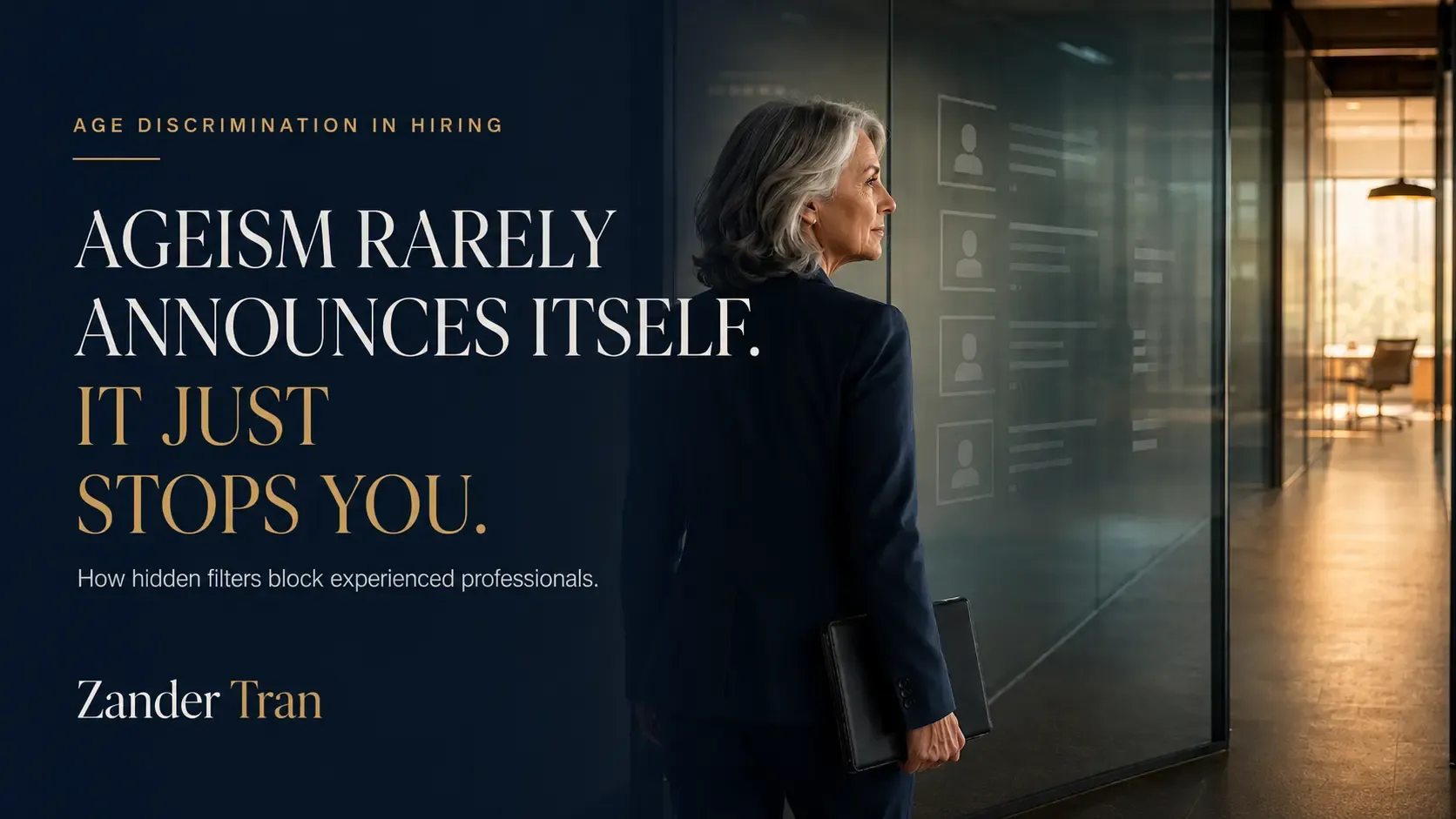
She kept a spreadsheet. Company. Role. Date applied. Date of the automated "thank you for your interest" email, which almost always arrived within four minutes.
211 applications over five months. Four interviews. Zero offers. She was qualified for every single role, more than qualified for most of them. 22 years running supply chain operations for two Fortune 500 companies, reduced to a spreadsheet of silence.
She started deleting her graduation year from her résumé in month three. Then her oldest job. Then anything more than 15 years back. Nothing moved the response rate.
If this sounds familiar, you already suspect what's happening. The hiring pipeline filters people like you before a human ever weighs in. If you want to see the path experienced professionals are using to build income outside that pipeline, watch The Invisible Expert Method. Free to watch. No email required. Then keep reading.
Because what's happening has a mechanism, not a mystery. This article covers the two gates between you and a callback, the invisible interview that happens before anyone dials your number, why applying harder doesn't fix either problem, and what actually works instead.
The Two Gates Between You and a Callback
There are two separate filters between you and a callback, and only one of them involves an actual human being.
Gate one is software. Applicant tracking systems score and rank applications before a person ever opens them. If the score comes back low, nobody reads what you wrote. These systems check for keyword matches against the posting. But they also pick up age signals that have nothing to do with keywords, like a graduation year or a certification that dates the résumé the moment it's read. Your Resume Was Never Meant for AI covers this mechanism in depth. The short version: the 30-second human skim your résumé was written for almost never happens anymore.
There's a wrinkle inside gate one that rarely gets mentioned. Most systems weight recency of skills and tools heavily, on the theory that recent experience predicts performance better than old experience. That's a reasonable design choice in the abstract. In practice, it means a résumé showing six years at one employer reads as less current than one showing six job changes in six years. That's true even when the first candidate did more, learned more, and carried more responsibility the whole time. Stability, the thing you spent two decades building, gets scored as staleness.
Gate two is a person carrying an opinion she may not know she holds. Research from Totaljobs in 2024 found that 57 is the average age at which employers start considering a candidate too old for a role. The same study found that 59% of HR decision-makers admit to making assumptions about candidates based on age alone. That's not a fringe number. That's most of the room.
Both gates operate quietly. Neither sends you a reason.
The Interview That Happens Before They Call You
Here's the part almost nobody talks about, because it doesn't feel like an interview. It feels like a Tuesday afternoon.
Before a hiring manager picks up the phone, sometimes before she's even finished reading the résumé, she types your name into a search box. What comes back in those first ten seconds functions as an actual interview round. Nobody scores it on a rubric. Nobody tells you it happened. But it decides who gets called back just as surely as anything said out loud in a conference room.
I watched this exact mechanic up close in 2015, working with a sports agent named Leigh Steinberg, the person Jerry Maguire was modeled after. His résumé was flawless. What came up when you searched his name was not. Every meeting he walked into started with someone who had already formed an opinion of him. That opinion came from a search he never got to prepare for. Your Resume Was Never Meant for AI tells that story in full.
The hiring version is smaller in stakes and identical in mechanism. A hiring manager searches your name. If nothing comes up beyond a static LinkedIn profile that hasn't changed in years, she has nothing to weigh against her assumption. If something does come up, it's often an old news item about a layoff, a company that no longer exists, or nothing relevant at all.
You don't get to attend this interview. You don't get a transcript. You just get the outcome: a callback, or silence.
Why Applying Harder Doesn't Fix It
The instinct when the callback rate drops is to increase the input. More applications, more keyword tweaks, a shinier professional summary, more coaching on how to sound sharp in an interview.
None of that touches either gate.
Applying to more roles increases your exposure to the same filter. That means more rejections at the same rate, not a better rate. Keyword-stuffing a résumé that's already deep in a keyword arms race just raises the bar the next applicant has to clear too. And interview coaching aimed at sounding younger and more energetic treats gate two as a performance problem. It isn't one. You're not losing points on delivery. You're being weighed against an assumption that formed before you sat down.
This isn't a productivity problem. Working harder inside a filtering system doesn't beat the filter. It just means more hours spent losing the same way.
What Actually Works: Get Found Before You Apply
The professionals who stop losing to this pattern don't get better at clearing the gates. They make the gates less relevant.
That starts with flipping the search-box moment from the last section. If a hiring manager is going to search your name before deciding whether to call, give her something to find. A documented point of view, backed by specific problems you've solved, told with the detail only someone who actually did the work would know. Build that, and the invisible interview stops working against you and starts working for you.
What that looks like in practice isn't dramatic. A published breakdown of a problem you solved, specific enough that a stranger searching for that exact problem finds you attached to the solution. A recommendation written by a former colleague and posted somewhere public instead of buried in a private reference call. None of it requires a large following. It only requires existing somewhere she can find it.
The stronger version skips the pipeline before it starts. Consulting work, teaching, contract engagements: a meaningful share of the best opportunities at this stage never touch an ATS at all. They go to the person whose name someone already recognized. The Invisible Expert Method walks through exactly how to build that kind of visibility, without a following and without going on camera. Free to watch. No email required.
Two notes, in case your situation is slightly different from what's described here. If what you're dealing with is happening inside a job you already have (being sidelined, managed out, passed over for an internal role), that's a related but separate mechanism. It's covered in Ageism in the Workplace. And if you're also rethinking the bigger shape of what comes next, not just the next application, Career Change at 50 is the place to start.
You didn't imagine this. The gates are real, and they're consistent. A lot of qualified people are hitting them at the same rate you are, for reasons that have nothing to do with what you can actually do.
None of that means the process gets fairer if you wait it out. It won't, not on a timeline that helps you now.
What changes the outcome is becoming visible before the gates get a vote: findable, documented, backed by the judgment two decades actually builds. That's what The Invisible Expert Method walks through, built for exactly this situation. Free to watch. No email required.
Watch The Invisible Expert Method
19 years building authority platforms for celebrities and executives. Now I built one for myself, without going on camera. Watch the free training to see exactly how it works.
Watch FreeWhat is age discrimination in hiring?
Age discrimination in hiring happens when an employer rejects or passes over a qualified applicant for reasons that trace back to age rather than fit. The Age Discrimination in Employment Act protects applicants 40 and older at companies with 20 or more employees. Illegal and provable are different things, though. Most applicants never get a clear enough signal to prove intent. That's why the more useful question is usually what to do about it, not how to litigate it.
How do employers screen out older job candidates?
The most common mechanism is applicant tracking software that scores résumés before a person reads them, weighting factors like keyword density and how recently a skill was used. Neither of those settings says "age" anywhere in the system. But a résumé built over 20-plus years trips both of them without a single word about how old you are. The result is a low score with no explanation attached.
Do employers search your name before hiring you?
Yes, often before they finish reading the résumé. A hiring manager typing a candidate's name into a search box functions as an unscored, invisible interview: what comes back, or doesn't, shapes the impression she carries into every later step. A candidate with no visible record beyond a static profile gives her nothing to weigh against assumptions she may not realize she's making.
What are signs of age discrimination in a job interview?
The clearest signs are indirect. Feedback that lands on "not the right fit" with no specifics, or a question about your "long-term plans" that's really asking how much runway you have left. An interviewer who never engages with the depth of your experience, as if the years on your résumé were a liability to explain rather than an asset to explore. Any one of these could be nothing. A pattern of them rarely is.
How do you fight age discrimination in hiring?
Two things, in order. Document the specifics: dates, what was said, how your qualifications compared to whoever got the role. That protects you regardless of which path you take next. Then decide whether you're fighting this fight inside the current system or building visibility that makes the system's filters less relevant to your income. The second path is usually faster, and it doesn't require proving anyone's intent in a courtroom.