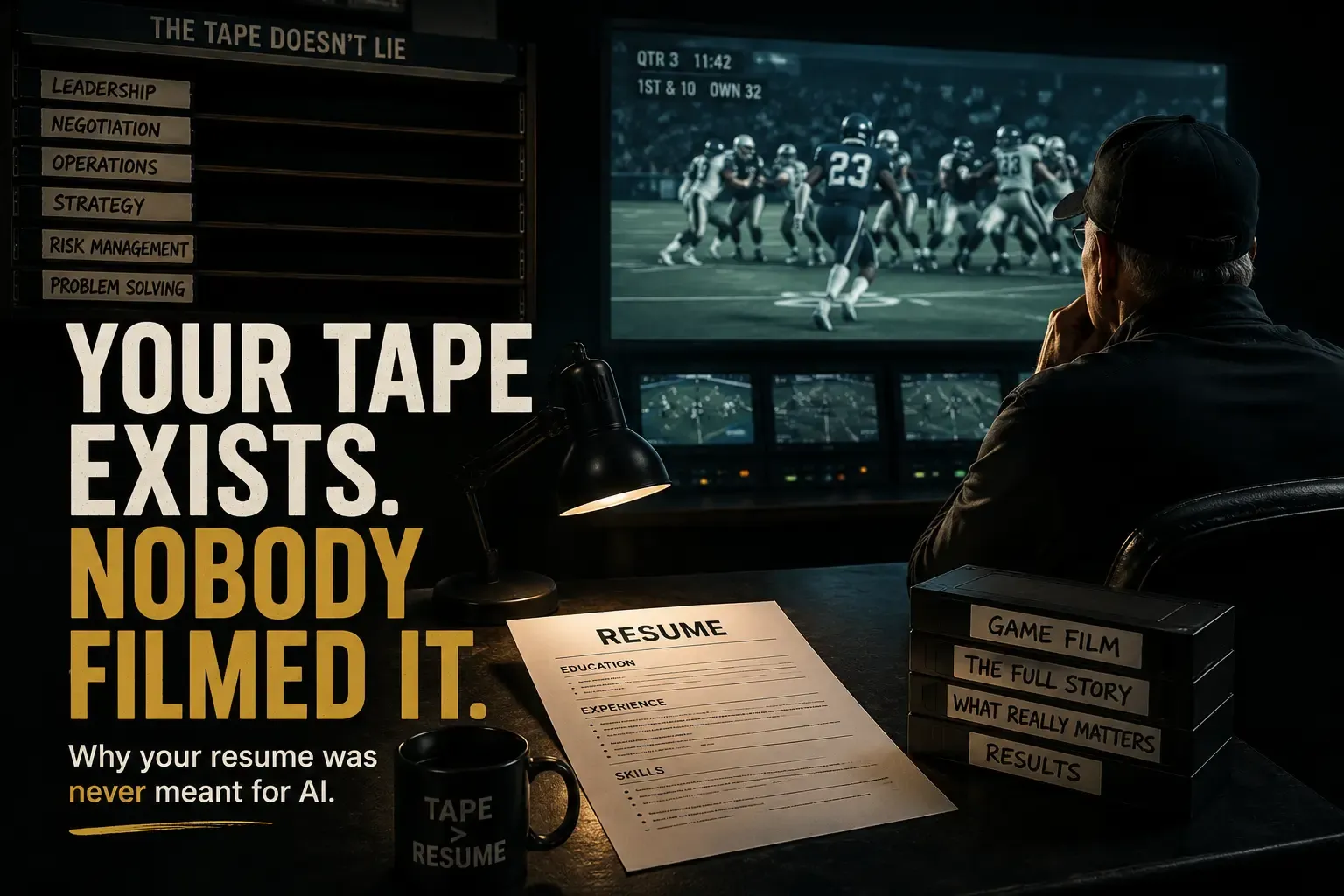
Your resume was never meant for AI.
It was written to persuade a person. Someone who would skim it for 30 seconds and decide you were worth a phone call.
That person doesn't read it first anymore. Software does. And software doesn't read it the way she would.
I want to show you why polishing that document harder is a losing move, and what to build instead. But first I have to take you somewhere most people never see from the inside: professional sports.
What a sports agent taught me about reputation
In 2015, I was brought in to work with Leigh Steinberg.
If you don't know the name, you know the movie. He was the inspiration for Jerry Maguire. For decades, he was the most famous sports agent in the world.
His resume was the kind you can't argue with. Decades at the top. The biggest names in football. Record-setting contracts. A client list other agents would trade everything for.
But that's not what the internet said.
In 2015, Google was what AI is today. It was the machine people asked when they wanted the truth about someone. Type a name, read the first page, done. Whatever showed up there was the truth, as far as the world was concerned.
And what showed up for Leigh was a handful of old news stories from his hardest years. Not the full story. Not the comeback. Just the worst chapters, frozen at the top of the page.
Think about the position that put him in. Every negotiation, every speaking invitation, every potential client started with someone typing his name into a search box. His decades of expertise never got to make the first impression. The machine made it for him.
His resume said one thing. The machine said another. The machine won. The machine always wins.
So we didn't touch his resume. We built a body of work instead.
We published, constantly. His expertise and his perspective, in his own voice, in volume, week after week. We fed the machine the bigger narrative until it understood who he actually was.
It took time. But the first page changed. And when the first page changed, people changed. They came into meetings already understanding his expertise. The old stories didn't vanish. They just stopped being the whole story.
Here's the part that matters for you. We never fixed the resume, because the resume was never broken. The visible record was. Once I saw that clearly, I saw it everywhere.
That formula became my career. Over 19 years, I ran the same play for celebrities, doctors, authors, and companies. Some you'd know by name. None of them found me through a resume. They sought me out for one specific skill: I knew how to make the machine understand who someone really was.
And working inside pro sports taught me something else. Something athletes have always known, and the rest of us are only now being forced to learn.
Athletes have two documents. You have one.
Every pro athlete has a spec sheet. Height, weight, 40-yard time, stats. It's their resume.
And no athlete in history was ever signed off the spec sheet.
The spec sheet decides who gets watched. The tape decides who gets paid. Scouts use the numbers to narrow the list. Then they watch the film. They want to see how the player moves when the play breaks down, what he does when nobody's open. The body of work is what earns the contract.
Athletes have always lived with this, because their work is public by default. Every game is filmed. Every play is recorded. Their expertise has a visible record anyone can check.
Now look at your career.
25 years of real work, and almost all of it happened behind closed doors. In conference rooms and documents stamped confidential. In late-night calls where you solved the problem and someone two levels up presented the solution.
You were brilliant in rooms with the door shut. That was the deal. The company got your best thinking, and in exchange your name stayed inside the building.
Your tape exists. Nobody filmed it.
So when the career disruption comes, and at this stage it usually arrives uninvited, you reach for the only document you have. The spec sheet.
This was always a structural weakness in how corporate careers work. You just never had to pay for it before. The human reading your resume could call a reference. She could trust the brand names on your work history and fill in the gaps with judgment.
The machine doesn't fill in gaps. The machine reads what's there.
The machine reads first now
Here's what actually happens to your resume in 2026.
Before a human being ever sees it, screening software has scored it and ranked it against hundreds of others. The 30-second skim you wrote it for doesn't happen anymore. What happens is a database query.
And that query can't see what matters about you. It can't see the judgment you built across every recession of your career. It can't see that you were the person everyone called when the project caught fire. 25 years of expertise goes in. A keyword match score comes out.
Then there's the part nobody says out loud. Age signals are everywhere in a resume. Graduation years. The length of the work history. The technologies you started on. Sometimes the email address itself.
And those signals get used. Research from Totaljobs in 2024 put exact numbers on it: 57 is the average age at which employers consider a candidate too old for a role. And 59% of HR decision-makers admit to making assumptions about candidates based on age alone.
You already know why the callbacks stopped. Everyone our age knows.
A spec sheet, read by a machine, filtered for age. That's a closed loop. There's no version of your resume that beats it, because the problem was never the document. The problem is that the document is all you have.
And suppose you beat the odds. The software scores you high. A human pulls your name from the stack.
Her next move isn't a phone call. It's a search box. She types your name, the same way everyone typed Leigh's in 2015, and whatever comes back is your real first interview.
Pass the machine and you still land in front of the machine. The resume's best possible outcome is a search you haven't prepared for.
Why fixing it harder makes it worse
The standard advice says optimize. Add keywords. Use the right template. Run it through an AI checker. Tailor it for every posting.
So you do. And so does everyone else.
Your AI-optimized resume now competes against 500 other AI-optimized resumes, all read by AI. When every document is optimized, optimization stops meaning anything. The filter just tightens somewhere else. And the somewhere else is usually not in your favor.
It's an arms race where you pay to stand still.
Put it in sports terms. Polishing your spec sheet is shaving a tenth of a second off your 40-yard time while nobody films you play. The number can be perfect. Without the tape, there's nothing for anyone to believe in.
I watched this exact dynamic in 2015. Leigh's credentials were already excellent. Improving the document was never on the table, because the document wasn't where his reputation lived. Reputation lives in the visible record. It did then. It does now.
The difference is that in 2015, the machine deciding reputations was Google. Today it's the AI systems that millions of people ask questions every day, including the AI now sitting on top of Google itself. Same game. Higher stakes. New referee.
The inversion: build the tape
So stop asking to be picked.
That's the whole move. Everything else is detail.
A resume is a request. It asks an employer to choose you out of a pile. A body of work makes no request. It sits in public, gets found, and speaks for itself, the way game tape speaks for an athlete.
Maybe you're thinking your LinkedIn profile already covers this. Look at it honestly. It's the spec sheet with a photo. Job titles and dates, plus a summary written like a press release. It says what you were hired to be. It shows nothing about how you actually think. A profile gets you ruled in or ruled out. It doesn't make anyone seek you out.
Here's what the tape looks like for an expert who isn't an athlete.
You've answered the same questions hundreds of times across your career. Those answers are the tape. Captured once, published under your name, specific enough that someone searching for that exact problem finds you attached to the solution.
A clear point of view on where your industry is going. That's tape.
The story of a problem you solved, told with the details only a practitioner would know. The expensive mistake you watched companies make over and over, and what it cost them. Tape.
If you want to know where yours starts, it starts here: list the 10 questions you've been asked most often across your career. The ones you answer without thinking. Each one is something a stranger types into a search box or asks an AI tonight. Each one is a piece of tape you could publish this month.
I've been calling it tape this whole time. That wasn't an accident. The average person now watches 17 hours of online video a week, more than two full working days, according to Wyzowl. Video is where the attention already is. And a person explaining what they know is the most convincing tape there is. It always was. It's why scouts watch film instead of reading the stat sheet.
Which runs straight into the objection I hear most. You're not going on camera, and you're not about to start now. Fine. You don't have to, and you have two ways around it. A podcast is tape: you talk, nobody sees you. And if you want the reach of video without the camera, AI can now put your expertise on screen in your words and your voice. How that works is its own subject, not this one.
So notice what's missing from all of this. No dancing. No vlogging. No going viral. You want the income and the recognition, and those come from being findable and credible. Fame is a different business.
You've probably watched people half your age build followings on knowledge you've carried for decades. It stings. But look at what they actually have. Their expertise is usually thinner than yours. What they have is a visible record, and a visible record beats invisible depth every time. That's not cynicism. It's how machines decide what to show people.
Because here's where the machine flips to your side. When someone asks an AI system who understands your field, the answer comes from the visible record. The same kind of machine that filters you out of hiring pipelines will cite you and send people to you, if you give it a body of work to read.
This is exactly what we did for Leigh in 2015. We gave the machine of that era something true to read, and the machine repeated it. The machines changed. The play didn't.
One honest caveat about cost. In 2015, building a visible body of work took a celebrity budget. A team of writers and producers working for months. That's why only famous people did it.
Today, one person at a desk can run the same play. The tools that read resumes will also write alongside you and edit alongside you. The cost of building a visible body of work has collapsed, and it happened in the last three years.
AI didn't replace your expertise. It replaced your excuse.
The window
One more thing from 2015, because the parallel is too exact to ignore.
The people who built their visible record early, while Google's first page was still up for grabs in their niche, owned that page for years. The ones who waited found the territory occupied. Catching up was possible but expensive, and the gap never fully closed.
The same land grab is happening right now inside AI systems.
Maybe you're thinking this doesn't apply to you yet, because you still Google things. So does almost everyone.
But open Google and look at what comes back now. The top of the page isn't ten blue links anymore. It's an answer, written by AI, assembled from the visible work of people the machine trusts on that topic, with a few citations underneath.
The search engine you still use became an AI system while you weren't looking. Google you, ask ChatGPT, it makes no difference. An AI reads the visible record and decides what to say.
In 2015, the prize was the first page. Today the prize is the answer itself. And the answer has fewer names in it than the first page ever did.
These systems are forming their picture of who the experts are. Whose work gets cited. Whose name comes back when someone asks a question in your field. That picture is being assembled from what's visible today.
If you're invisible, you're not in the picture. The machine can't recommend what it has never read.
And this compounds in both directions. Every month of publishing builds a record that keeps working while you sleep. Every month of invisibility cements someone else's name in the spot where yours could be.
There's no countdown clock here, and I won't invent one. It's just structure. Early visibility compounds. And you have a head start most people can't see: the 20-plus years of expertise is the hard part, and you already did that. The only missing piece is the visible record.
The spec sheet was never the asset
Leigh Steinberg had one of the best resumes in the history of his profession. It couldn't defend him, because reputation doesn't live in a document. It lives in what the machine can see.
Athletes never trusted the spec sheet. They built tape, because tape is what gets believed.
You have decades of real expertise, and right now almost nobody online knows you exist. That's the actual problem. Another resume revision can't fix it. A visible body of work can.
The resume asks. The tape answers.
Build the tape.
One letter a week. Build the tape.
I write one letter a week about building a visible body of work with AI, for professionals with 20+ years of expertise who would rather be respected than famous. Honest timelines, no hype.
Get the newsletterDoes AI really read my resume before a human does?
Yes. At most companies, screening software scores and ranks your application before a recruiter opens it. If the score is low, no human ever reads it. The quick human skim you wrote the resume for is no longer the first gate. It's often not a gate at all.
At what age do employers consider candidates too old?
57, on average, according to 2024 research from Totaljobs. The same study found that 59% of HR decision-makers admit to making assumptions about candidates based on age alone.
What counts as a body of work if I'm not an athlete?
Published answers to the questions you've answered hundreds of times in your career. A stated point of view on where your industry is going. Stories of problems you solved, with the details only a practitioner would know. Anything public, under your name, and specific enough that a stranger searching for that exact problem finds you attached to the solution.
Is a LinkedIn profile a body of work?
No. A profile is the spec sheet with a photo: job titles, dates, a summary. It shows what you were hired to be, not how you think. A body of work is the thinking itself, published where machines and people can read it.
Does my body of work have to be written, or can it be video?
It can be writing, audio, or video. The average person now watches about 17 hours of online video a week (Wyzowl), so video is where attention already lives, and someone explaining what they know is the most convincing proof there is. You don't have to be on camera to make it. A podcast lets you talk without being seen, and AI can now produce video in your words and your voice using an AI avatar. The format matters less than showing up under your name, where machines and people can find you.
Do I have to become an influencer?
No. An influencer performs for an audience. You publish expertise for the one person searching for exactly what you know. The goal is to be findable and credible, not famous. Only one of those asks you to perform.
How do AI search engines decide which experts to cite?
From the visible record. AI systems assemble their answers from published work they can read, and they cite the names attached to it. If nothing exists online under your name, you're not in the answer. The machine can't recommend what it has never read.
Where do I start?
Start with the questions you already answer in your sleep. List the 10 you've fielded most across your career, then publish your answer to each one, under your name, one at a time. You're not creating new expertise. You're recording what's already in your head.